
Studies & Impact Reports
Research from across the East Coast Greenway corridor highlights the powerful health, safety and economic returns of active transportation investments from Maine to Florida.
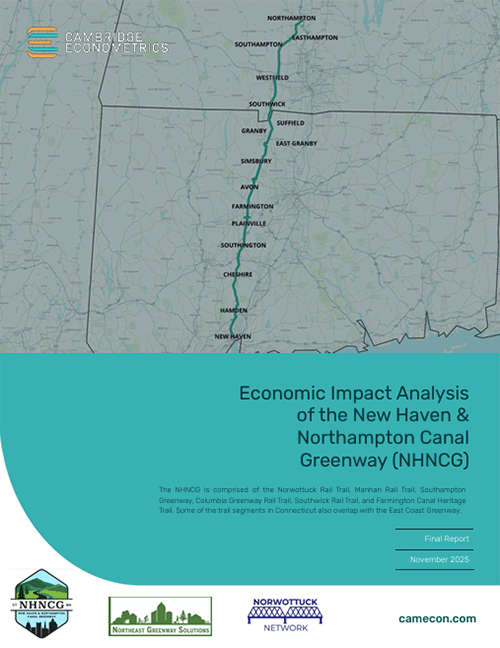
Economic Impact Analysis of the New Haven & Northampton Canal Greenway
According to Cambridge Econometrics, the 81-mile Farmington Canal Heritage Trail from New Haven, Connecticut, to Northampton, Massachusetts — expected to be completed within the next five to six years — could spark major economic benefits for the region. “Existing trail users spend an estimated $15.1 million each year, while users of a completed trail are estimated to spend $32.0 to $53.8 million annually,” according to the study.
Investing in Our Future
The study, “Investing in Our Future: Quantifying the Impact of Completing the East Coast Greenway in the Delaware River Watershed” was prepared by NV5 and EConsult Solutions in March 2019. The report’s key finding: Completing the East Coast Greenway in the Greater Philadelphia region would mean $3 billion in public health, environmental, and economic benefits.
The Impact of Greenways in the Triangle
The East Coast Greenway Alliance commissioned a study in 2017 to put numbers on what we know to be true: Greenways are good for economic growth. Prepared by Alta Planning + Design and sponsored by GSK, the report finds that the East Coast Greenway generates $90 million in total benefits annually for the Triangle region, from gains in health and the environment to transportation and access benefits, economic gains, and increased property values.
The Economic, Health and Environmental Benefits of Completing The Capital Trails Network
The Capital Trails Coalition, in partnership with a team of experts, spent two years developing an impact report to quantify the economic, health and environmental benefits of the region’s 881 mile multi-use trail network. A key hub of the East Coast Greenway, the Washington D.C. region is uniquely positioned to have the best trails system in the nation.
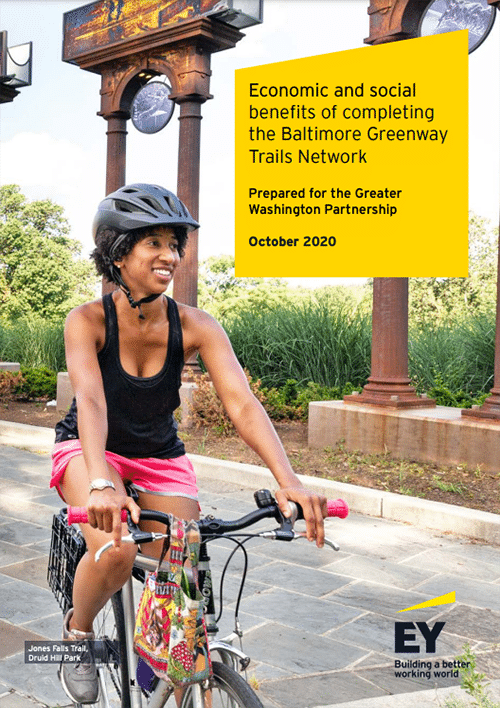
Economic and Social Benefits of Completing the Baltimore Greenway Trails Network
Ernst & Young LLP on behalf of the Greater Washington Partnership released a report on the Economic and Social Benefits of Completing the Baltimore Greenway Trails Network. The study examines the potential economic and social benefits of a $28 million plan to expand and connect existing trails in Baltimore City to complete the Greenway Trails Network, a key stretch of the East Coast Greenway. Only 10 miles of trail construction is needed to complete a 35-mile trail system that will provide access to a safe, car-free trail network that connects 75 neighborhoods to new recreational and economic opportunities. When finished, the trail network has the potential to unlock new economic, health and social benefits for city residents.